
AI in Australian Sport: How Performance Teams Use Machine Learning in 2026
Australian high-performance sport is a more sophisticated applied machine learning environment than most people outside it realise. The datasets are small by commercial standards, the margins that matter are tiny, and the feedback loop is unusually honest — the stopwatch does not care how good the model looked in validation.
We have worked in this space, including generative AI and machine learning work with Swimming Australia. This is a broader look at what performance teams are actually running in 2026.
Where machine learning is genuinely earning its place
Automated video and movement analysis
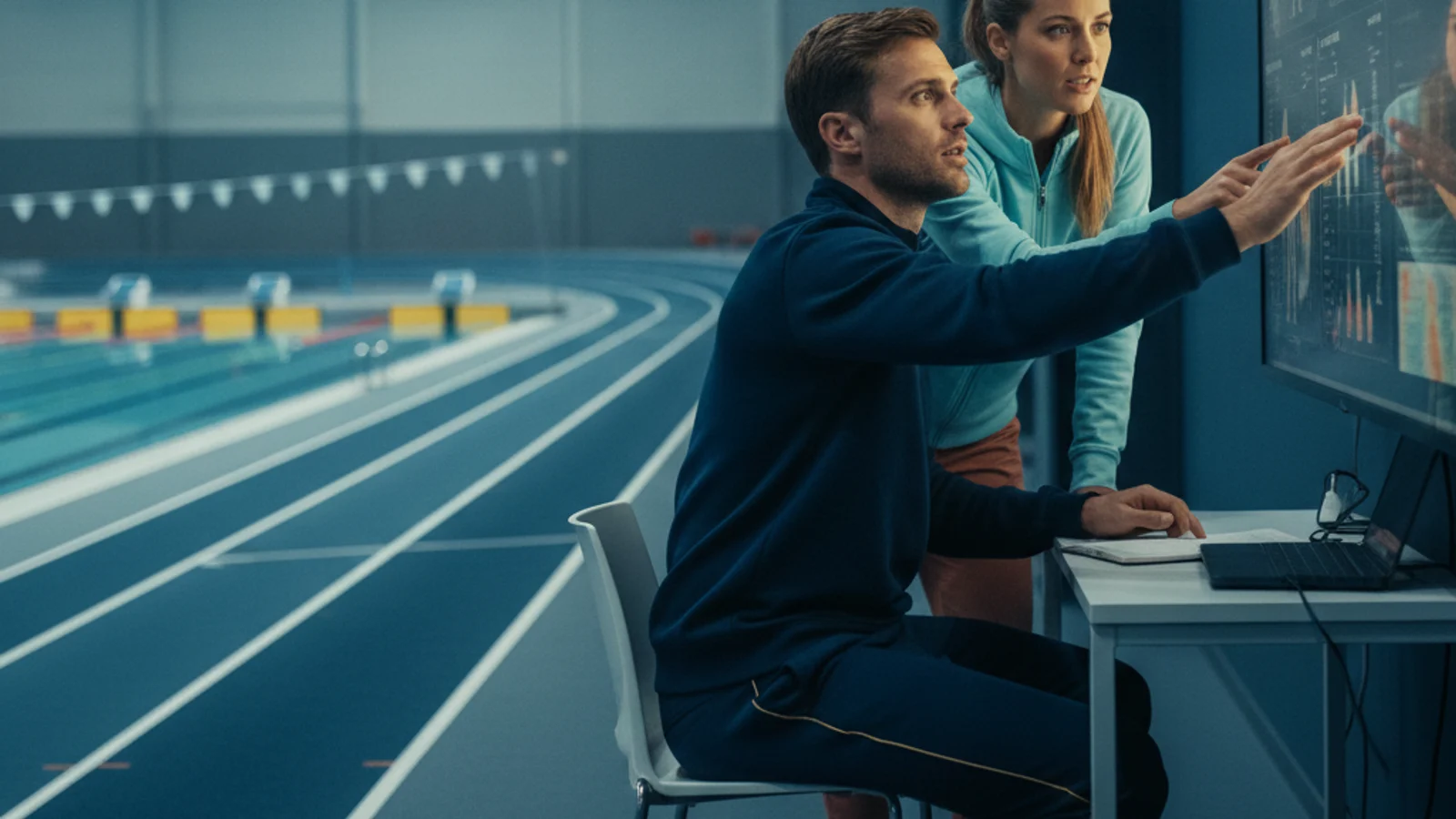
The highest-volume win. Historically an analyst watched footage and manually tagged events — hours of work per session. Pose estimation and event detection models now do the first pass automatically: stroke rate, stride length, jump height, contact time, tactical positioning.
The analyst does not disappear. They move from tagging to interpreting, which is where their value always was.
What makes it hard: sport-specific movement rarely matches the general-purpose training data these models ship with. Getting from "works on the demo" to "works on wet athletes in a 50m pool under competition lighting" is most of the project.
Injury and load risk modelling
Combining GPS, accelerometry, wellness questionnaires, training load and injury history to flag athletes at elevated risk.
This is the area with the biggest gap between marketing and reality. The honest position: these models are useful for flagging athletes for a conversation with a physio. They are not reliable enough to make selection decisions on their own, and the published evidence for strong individual-level predictive accuracy remains thin.
What makes it hard: injuries are rare events. A squad of 40 athletes over a season produces very few positive cases, which is a genuinely difficult modelling problem regardless of technique.
Race and match strategy modelling
Simulating race splits, pacing strategies, or tactical scenarios against historical data. Particularly valuable in timed sports where the optimisation problem is well-defined.
What makes it hard: small data. A model of elite 200m freestyle strategy has a few thousand relevant races to learn from, not millions.
Talent identification
Screening larger populations against performance-correlated attributes. Useful as a funnel widener, dangerous as a filter — the historical data encodes the biases of past selection practice, and a model trained on it reproduces them.
Language models for knowledge access
The newest addition. Coaching staff querying years of session notes, physio reports and video annotations in natural language. Genuinely useful for institutional memory, which in sport is otherwise carried in the heads of long-serving staff.
What separates the systems that work
Data infrastructure before models. Most performance programmes have data scattered across GPS platforms, spreadsheets, video systems and a physio database that does not talk to anything. Consolidating that is unglamorous and it is the highest-return work available. Teams that skip it build models on foundations that shift every season.
Coach trust is the actual product. A model that is 5 per cent more accurate but that coaches do not believe delivers zero value. Explainability is not a nice-to-have here — a coach needs to understand why the system flagged an athlete before acting on it.
Small-data discipline. Elite sport datasets are small. That means rigorous cross-validation, scepticism about impressive-looking results, and comfort with saying "not enough data to tell". Techniques that work on millions of rows will overfit spectacularly on hundreds.
Athlete privacy taken seriously. Health, wellness and performance data on identifiable individuals, often including minors in development pathways. This carries genuine obligations under Australian privacy law and, increasingly, athlete association agreements.
Integration into the existing week. If the output does not arrive in the format and timeframe the coaching staff already work in, it will not be used. The best model delivered on Thursday for a Tuesday decision is worthless.
What we would tell a performance director starting out
- Start with one question the coaching staff actually asks. Not "what could we do with AI" — "how do we know when an athlete is under-recovering?"
- Audit the data first. You will likely find the answer is not modelling, it is that three systems disagree about the same session.
- Build the boring pipeline. Reliable, consolidated, historical data is a durable asset. Any given model is not.
- Validate against outcomes you did not train on. The next season, not a held-out slice of the last one.
- Keep humans deciding. The model informs. The coach decides. Every credible programme we have seen works this way.
Building this properly
The engineering challenges here are real but not exotic: data pipelines, video processing at scale, careful modelling on small datasets, and interfaces that people under time pressure will actually use.
We have worked on the analytics side of this with Swimming Australia, and on operational platforms in adjacent sport with Sports First Aid.
If you are scoping something in this space, we are happy to talk it through, or you can read about how we run AI-assisted delivery.
Related reading
Related hiring services
Services for AI and data product teams
If this article is part of an AI roadmap, these pages are the best commercial follow-on paths into delivery capability.
Hire developers in the Philippines
Hire offshore developers for your Australian team
Use Lanex staff augmentation to add pre-vetted Philippines-based engineers who work your hours and integrate into your existing team.
Explore pageHire data engineers
Build stronger data and AI foundations
Use Lanex data engineers for pipelines, warehousing, analytics infrastructure, and AI-readiness work.
Explore pageHire software architects
Get senior architecture guidance
Best fit when you need better technical direction across systems, cloud design, integrations, and scaling decisions.
Explore pageMore Articles



Ready to hire your first offshore developer?
Book a free 15-minute discovery call. We'll understand your stack and team culture, then send you a shortlist of pre-vetted developers within 3–5 business days.
Book a Free Call